
The Deskless Workforce Isn’t Deskless Learning Anymore.
The Workforce We Built for Last—Is Finally Getting First Attention.

We built learning for people at desks while expecting our frontline teams to carry the performance of the business. We need to support people in their moment of need.
I like working in the operational space, over the years and now in my consulting work I find supporting the frontline workers satisfying yet the majority of these workers are often deskless. The people closest to customers, patients, the products being made often had the least access to meaningful, practical learning.
Not by intent. But by design. Learning systems were built for:
people at desks
people with time to complete modules
people who could step away from the work
But that’s not where a large portion of real work happens.
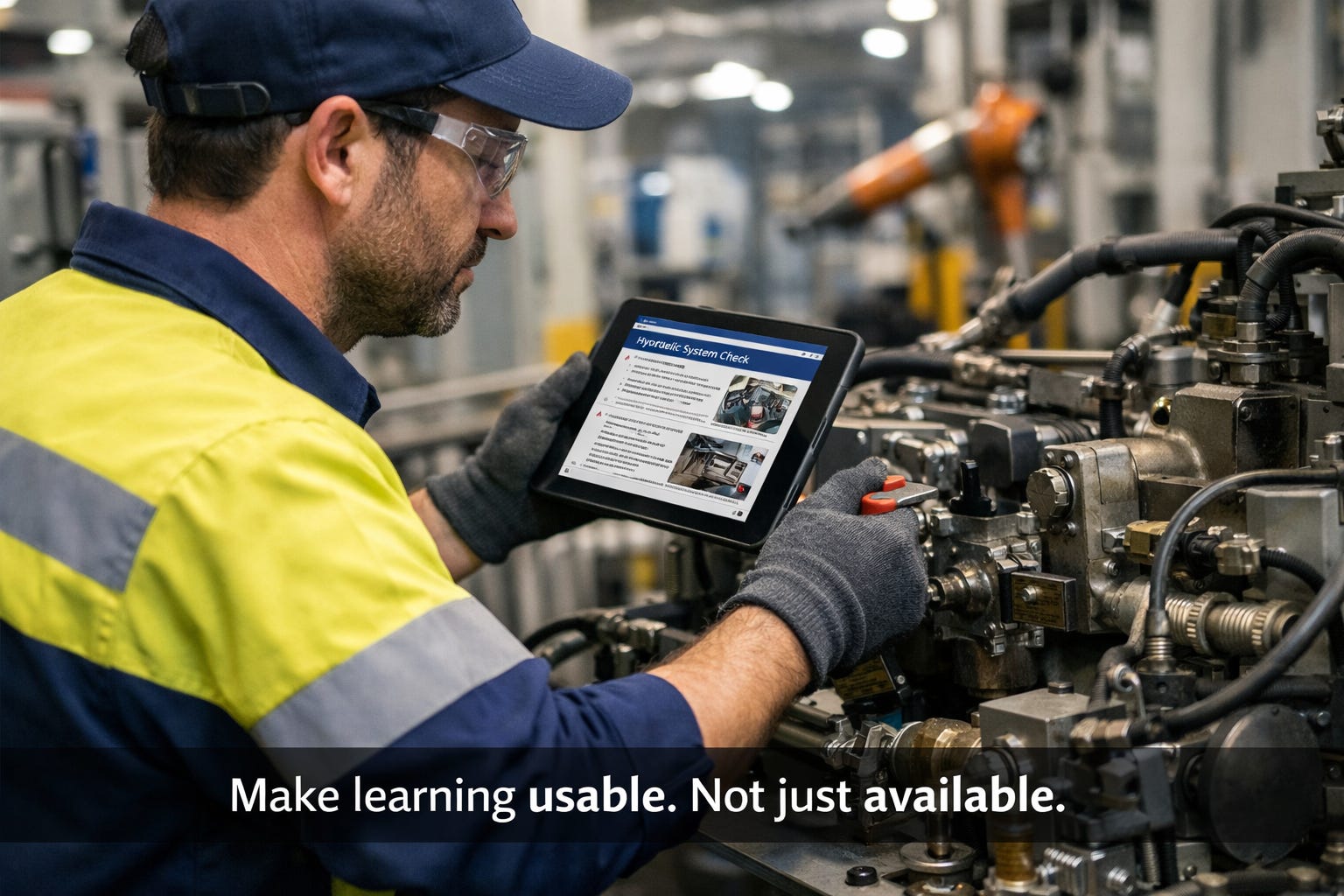
What’s changing now
I am seeing technology catching up and organizations are finally designing learning with the frontline in mind intentionally, supporting people in their flow of work.
And it’s long overdue.
Because whether it’s a call center rep, a nurse, a technician, or a shift supervisor… support when and where needed is what enables a person to perform successfully or not.
What’s actually working
The most effective approaches I’m seeing aren’t more complex, they’re more practical:
Mobile-first, not desktop-dependent
Short, targeted learning moments
Support in the flow of work, not separate from it
Manager reinforcement at the shift or team level
Content designed for real scenarios, not just concepts
Because for frontline teams, learning isn’t an event.
It’s something that has to fit into everything else they’re already doing.
You don’t need a full redesign to start improving frontline learning. A few simple shifts can make a noticeable difference:
1. Shrink the learning moment. Instead of a full module, ask:
“What’s the one thing someone needs to do differently today?”
2. Bring learning into a huddle. Turn 5 minutes of a team meeting into:
one concept
one example
one expectation
3. Make it immediately usable. End any learning touchpoint with:
“Here’s what this looks like on your next call / shift / interaction.”
Where I see this going
Organizations that get this right will start to see meaningful shifts in how work actually happens.
Customer experiences become more consistent because people feel more confident in how they show up day to day. Onboarding begins to move faster, with new hires finding their footing more quickly because the support around them is practical and accessible. Over time, you see stronger frontline leadership emerge as leaders actively guiding performance in real moments.
This shift isn’t really about learning at all. It’s about where organizations choose to invest their attention. When they focus on the people actually delivering the work and support them where and when they need, they’re supporting people’s success in a much more human, tangible way.
If you think about your own organization, how easy is it for your frontline teams to access and use learning support in the flow of work? Do you build in, assessments and target support? I’d love to hear what you’re seeing, share what’s working, and what still feels like a gap so we can all learn together.
Designing learning that truly works for frontline and deskless teams especially in high-demand environments is a core part of my work. If you’re rethinking how learning shows up for your workforce, I’d welcome the conversation.
#FrontlineLearning #DesklessWorkforce #LearningAndDevelopment #WorkforceTransformation #LearningStrategy #WorkflowLearning
Thanks, Bill. Your perspective is giving me lots to think. I don't know if I interpret point #2 correctly, but I've started imagining how to be more intentional in embedding learning in meetings, by focusing on a concept, example and expectation, that can be immediately applied. Something to try this week!