

I walked into that meeting proud of our metrics—and walked out realizing none of them answered the question that mattered.
My “aha” moment was as a new learning leader I was presenting a learning update to the operational leadership team. The report looked strong and included completion rates, solid satisfaction scores, and great participation as noted in number of classes.
I was really confident until one leader and me, “This is nice but what did it actually change to help my people improve their performance?”
I realized my team had measured activity, but we hadn’t measured impact to performance. We were not measuring what mattered to the business team.
And that moment is when I stopped caring about clicks-n-courses and focused on moving business metrics. I realized that someone completing a course doesn’t mean they can do something differently. And it definitely doesn’t mean the business outcome changed.
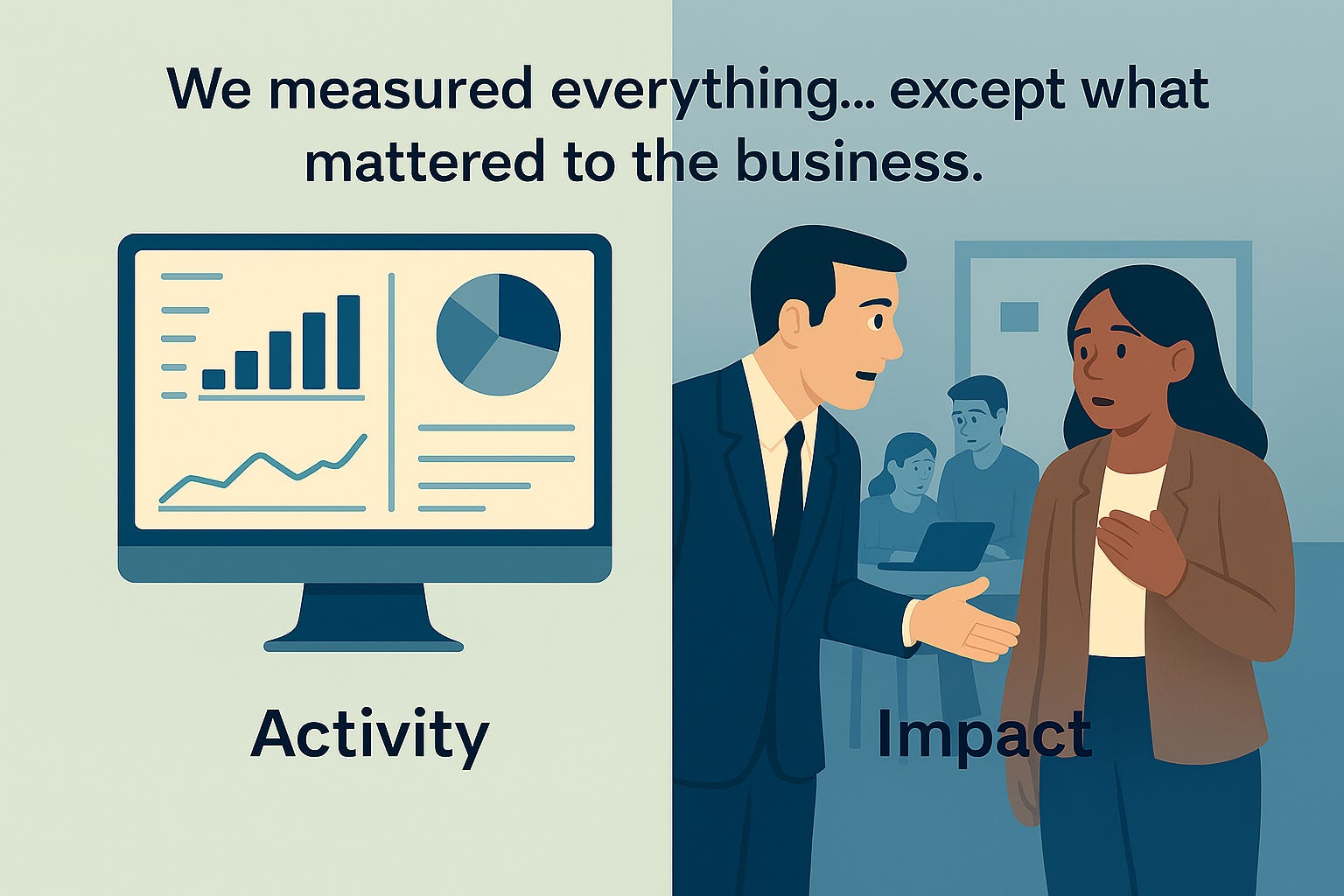
Fast forward and now I’m supporting new areas, and I sat down with a manager who had recently gone through a leadership program my team had developed. Instead of asking what they thought of it, I asked them, “What’s something you’re doing differently now?”
They didn’t mention a model or a framework. They shared specific actions where they chose to have:
a different kind of conversation with a teammate
a question they asked that changed the outcome
a decision they approached with more curiosity and gained more clarity because of it
This is where impact actually shows up in the business, in behavior, in decisions, in results. Impacting performance isn’t in the content. It’s in what people do with it.
The organizations that are starting to close this gap aren’t tracking more metrics. They’re tracking better ones. They’re looking for signals like:
Are the KPIs (or OKRs) trending as we want?
Are we keeping and retaining the people we want and need?
Are our teams working safer and more productively as we defined?
They’re connecting learning to the moments where performance actually happens.
This isn’t something different and here are a few simple ways to move from measuring activity to focusing on impact to performance right away:
✅ 1. Change one question
Instead of: “Did you complete it?” Ask: “What are you doing differently?”
✅ 2. Identify one behavior that matters
Pick one thing that should change:
a question a manager asks
a step in a sales conversation
a decision-making habit
Focus there.
✅ 3. Look for evidence in the work
Don’t wait for surveys. Listen for:
different conversations
better questions
stronger decisions
That’s your early signal.
✅ 4. Connect learning to outcomes
Ask your business partners:
What would success look like in the business?
How would we know something improved?
Partner and learn how they measure their performance and then trace your learning efforts and solutions back to that.
The goal isn’t to deliver more learning. It’s to help people perform successfully in ways that matter to the business using their metrics. Organizations that get this right aren’t proving that learning happened, they’re demonstrating that something changed because of it. Build the partnership that uses learning as a strategic business tool.
What are you measuring today? Where is it working and where does it fall short? How have you found ways to connect learning solutions to real business outcomes? Please share your insights so we may all keep learning together.
And if you’re working on connecting learning to business outcomes and showing the Return on Learning, I have a method that can help you prove your impact. Let’s grab a coffee and let me introduce ways to make strategy become fiscal proof.
#LearningImpact #LearningAndDevelopment #WorkplaceLearning #BusinessOutcomes #ROL #ReturnOnLearning #KPIs #MetricsThatMatter
Great post…as usual.
Most metrics I have seen , in training or otherwise, are looking backward and do not help organizations to go forward and improve. And i always keep in mind Goodhart’s law : when a metric becomes a target , it becomes a bad indicator!