
The Most Important Leadership Skill Isn’t Strategic
We Need to Stop Developing Leaders for Stability in an Unstable World

I don’t think leaders need to learn how to develop better plans right now, I think they need better ways to think forward with clarity and confidence when the plan breaks down.
Early in my career I was taken aside and told I needed to learn how to get comfortable when working in ambiguous situations. The world isn’t “black or white” I was told so get comfortable in the large grey space. The irony for me then was I was being asked to provide specific details leadership would use to set direction, create tasks and workflows, and execute against the defined, step-by-step strategy.
I learned the true lesson I realized is that the plan rarely survives first contact with reality.
Markets shift. Priorities change. Tools accelerates decisions before leaders feel ready. And in this ever fluid environment, the coaching I learned to embrace wasn’t to lean into strategy and absolutes but rather gain confidence and capability in the face of uncertainty, learning to have a “plan B” ready.
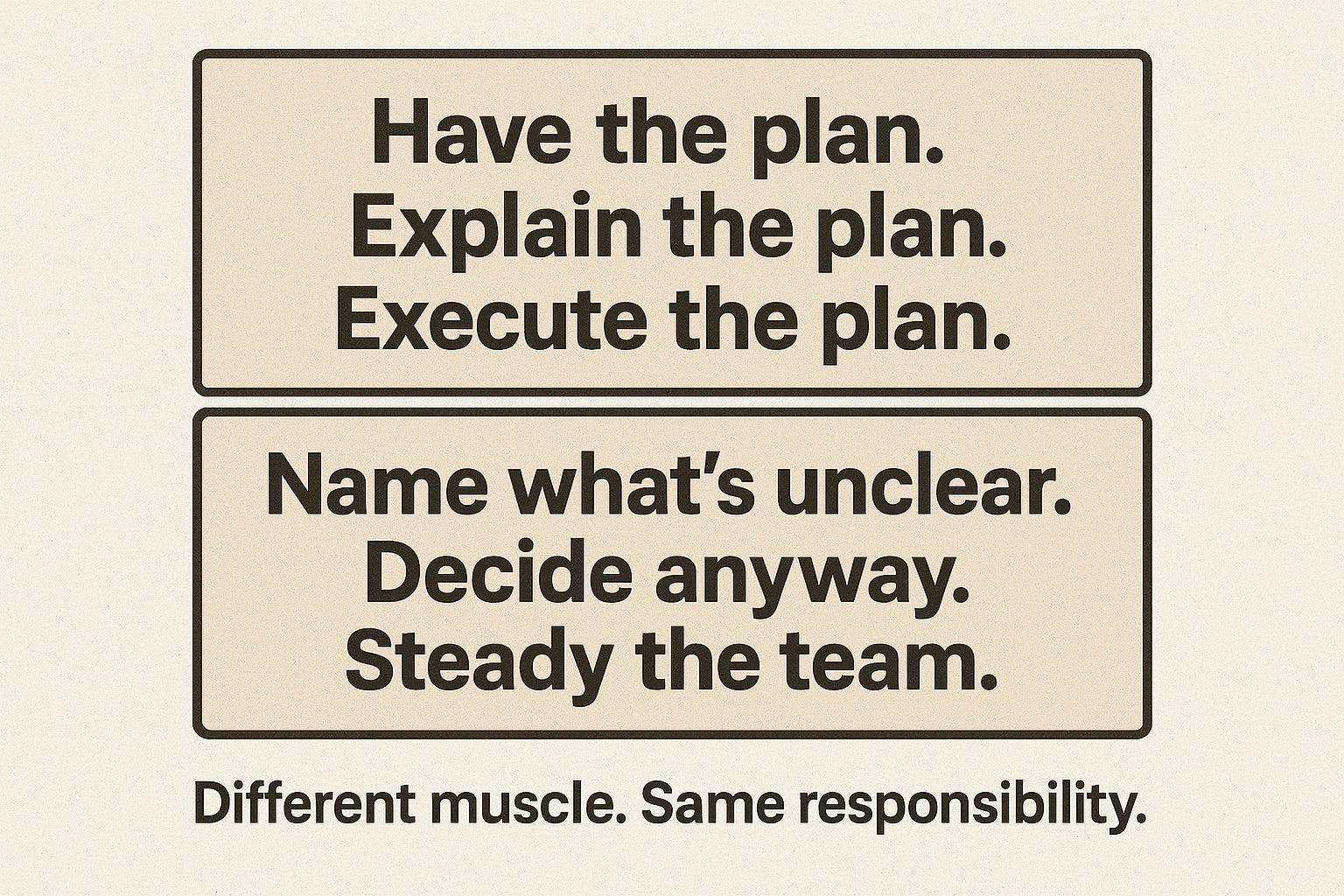
This shifted my perspective of developing leaders at all levels. I added opportunities to fail their way towards success, to be planful and flexible, and to get comfortable in moving away from how to plan and instead look towards how to lead when the plan is incomplete, outdated, or still forming.
Most leaders today aren’t struggling because they lack vision. They’re struggling because they’re expected to:
Make decisions with imperfect information
Lead teams through ambiguity they can’t fully explain
Balance speed with judgment while everything feels urgent
Traditional leadership programs don’t prepare people for that reality. They still reward certainty, polish, and decisiveness often at the expense of curiosity, sensemaking, and adaptability.
Leadership in uncertainty looks different.
It’s less about having the answer and more about asking better questions. It’s less about confidence in outcomes and more about confidence in the process and the team. It’s less about control and more about creating stability for others when things feel unsettled.
And here’s the part that often gets missed: these are learnable skills, but only if we design development differently.
What this looks like in practice
The organizations making progress are helping leaders build a few critical capabilities:
Sensemaking over forecasting. Helping leaders interpret signals, patterns, and weak data—rather than pretending certainty exists.
Decision quality over decision speed. Teaching how to slow thinking just enough to avoid costly errors in fast-moving situations.
Emotional steadiness over performance theater. Leaders don’t need to look like they have it all figured out. They need to help others feel grounded.
Conversation skills over communication plans. Navigating hard questions, ambiguity, and doubt in real time with real people.
What you can do now
A few practical actions leaders (and those supporting them) can take immediately:
Replace “What’s the plan?” with “What do we know, and what are we testing?” This normalizes learning instead of false certainty.
Name uncertainty out loud. It builds trust faster than pretending clarity exists.
Slow the decision just enough to surface assumptions. Ask: What would have to be true for this to work?
Focus on how decisions are made, not just what decisions are made. That’s where long-term leadership capability is built.
So where are you seeing leaders struggle most with uncertainty today? And where have you seen leadership rise precisely because the path wasn’t clear? Share your insights and experiences in the comments. These conversations matter more than ever.
And if you’re rethinking leadership development to better prepare leaders for ambiguity, change, and constant disruption, this is exactly the work I help organizations navigate—practically, thoughtfully, and grounded in real leadership challenges.
#LeadershipDevelopment #LeadingThroughUncertainty #AdaptiveLeadership #FutureOfLeadership #LeadershipStrategy