
Risk Is a Human Skill Problem
Your Biggest Risk Isn’t AI—It’s Poor Human Judgment

If risk lives in decisions, then developing better judgment might be the most important mitigation strategy we have.
A silver lining to the AI implementations I’m seeing is understanding that with this tool comes a degree of risk in terms of intellectual property and data security. In my past life, conversations around risk mitigation lived in controls, policies, technology, and compliance checklists. And those things still matter. But in conversations I’m having with leaders, especially as AI, speed, and complexity increase, I’m hearing a growing understanding that many of today’s biggest risks aren’t technical failures. They’re human ones.
What’s changing is that human skills such as judgment, critical thinking, communication, and ethical reasoning are no longer just “nice to have.” They’re becoming front‑line risk controls.
And that reframes the role of learning in a powerful way.
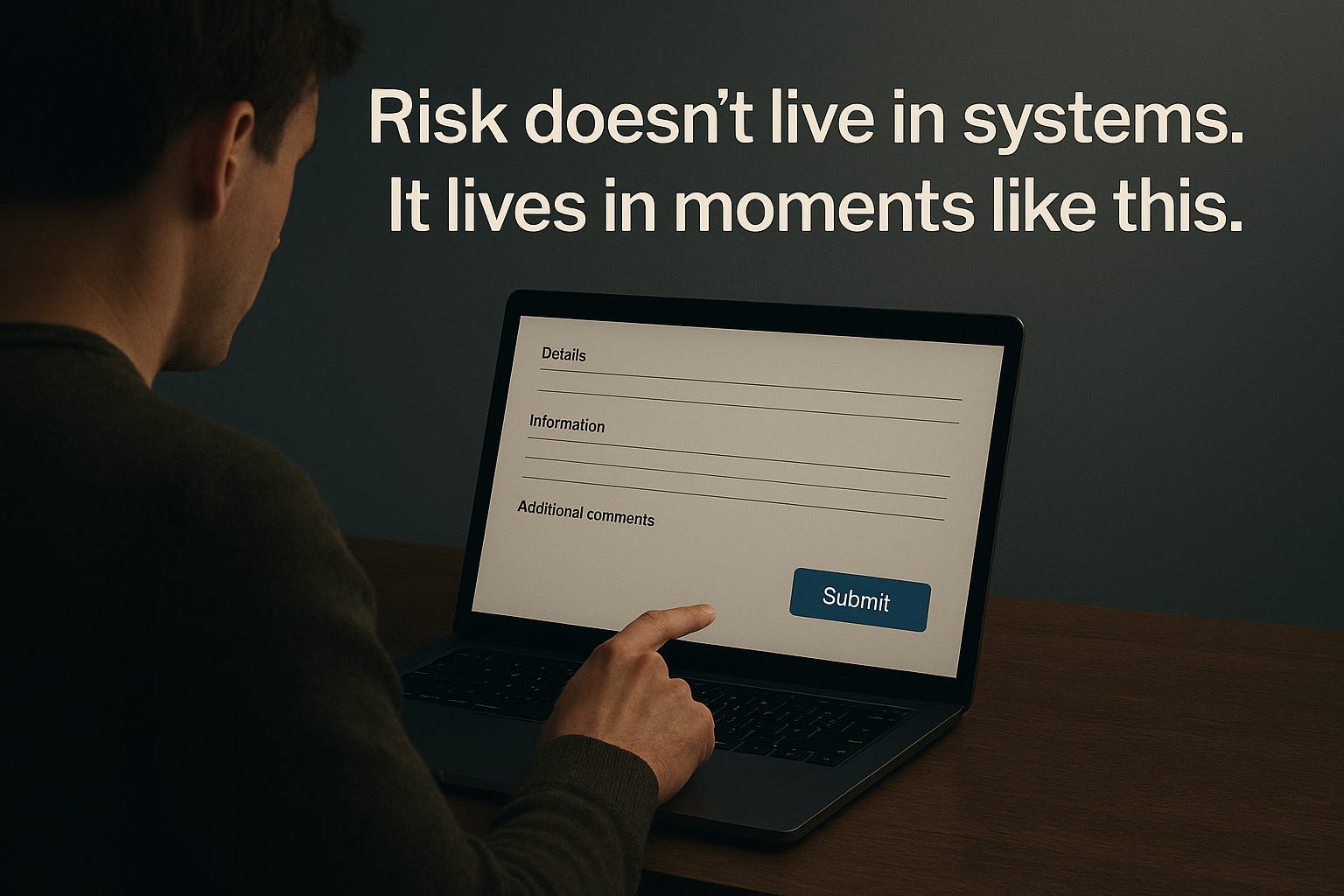
When work moves faster and decisions are made with imperfect information, risk doesn’t show up neatly labeled. It shows up in gray areas, moments where someone has to decide whether to pause, question, escalate, or proceed.
No policy can cover every one of those moments. That’s why I see human skills as a form of risk mitigation. Not soft skills. Capability skills.
The organizations making progress aren’t just adding more rules. They’re investing in helping people:
Think critically when data is incomplete.
Exercise judgment instead of defaulting to speed.
Communicate uncertainty without fear.
Recognize when human oversight matters more than automation.
In other words, they’re strengthening the decision‑making muscle of the organization. When this is working, learning looks different as it an active, strategic business tool that is:
Scenario‑based, not policy‑based.
Conversation (and context) driven, not content‑heavy.
Focused on judgment calls, not just correct answers.
Designed for moments of pressure, not ideal conditions.
People practice navigating trade‑offs, ambiguity, and ethical tension before those moments show up at scale. Here’s a few practical actions you can take immediately:
Name judgment as a skill, not a trait. Make it explicit that decision quality matters as much as speed.
Pause after decisions—not just outcomes. Ask: What signals did we notice? What did we miss?
Reward speaking up, not just being right. Psychological safety is a risk control.
Design learning around real decisions people face. If it doesn’t resemble the work, it won’t change behavior.
Where do you see humans in the loop exercising judgment acting as a risk factor in your organization today? And where have strong human skills prevented something from going wrong? Share your insights and experiences in the comments. These are the conversations organizations need to be having more openly.
And if you’re thinking about how to strengthen human judgment, communication, and decision‑making as part of your risk and performance strategy, this is exactly the work I help organizations navigate—practically, thoughtfully, and grounded in how work actually happens.
#HumanSkills #HumansInTheLoop #RiskManagement #LeadershipDevelopment #LeadershipStrategy #FutureOfWork