
From Courses to Pathways: Rethinking Upskilling
Adaptive Learning: Respecting What People Already Know

Years ago, I learned that the fastest way to frustrate capable people is to make them sit through training they’ve already mastered.
Earlier in my career, I spent a lot of time designing modular courses in our LMS, breaking content into focused chunks and using pre‑tests to help people move past what they already knew. The goal wasn’t to be clever; it was to respect people’s time. If someone demonstrated competence, they shouldn’t have to sit through material they’d already mastered. Those small design choices helped learners use their time more effectively and helped them, and the organization, achieve performance success faster.
That experience is why the renewed focus on adaptive learning feels so timely right now. What we were doing manually then, routing people based on what they knew and needed next, is exactly what today’s adaptive pathways are designed to do at scale. And in a moment where upskilling pressure is high and attention is scarce, that shift isn’t just nice to have, it’s essential.
This isn’t personalization for personalization’s sake. It’s respect for people’s time, experience, and real work.
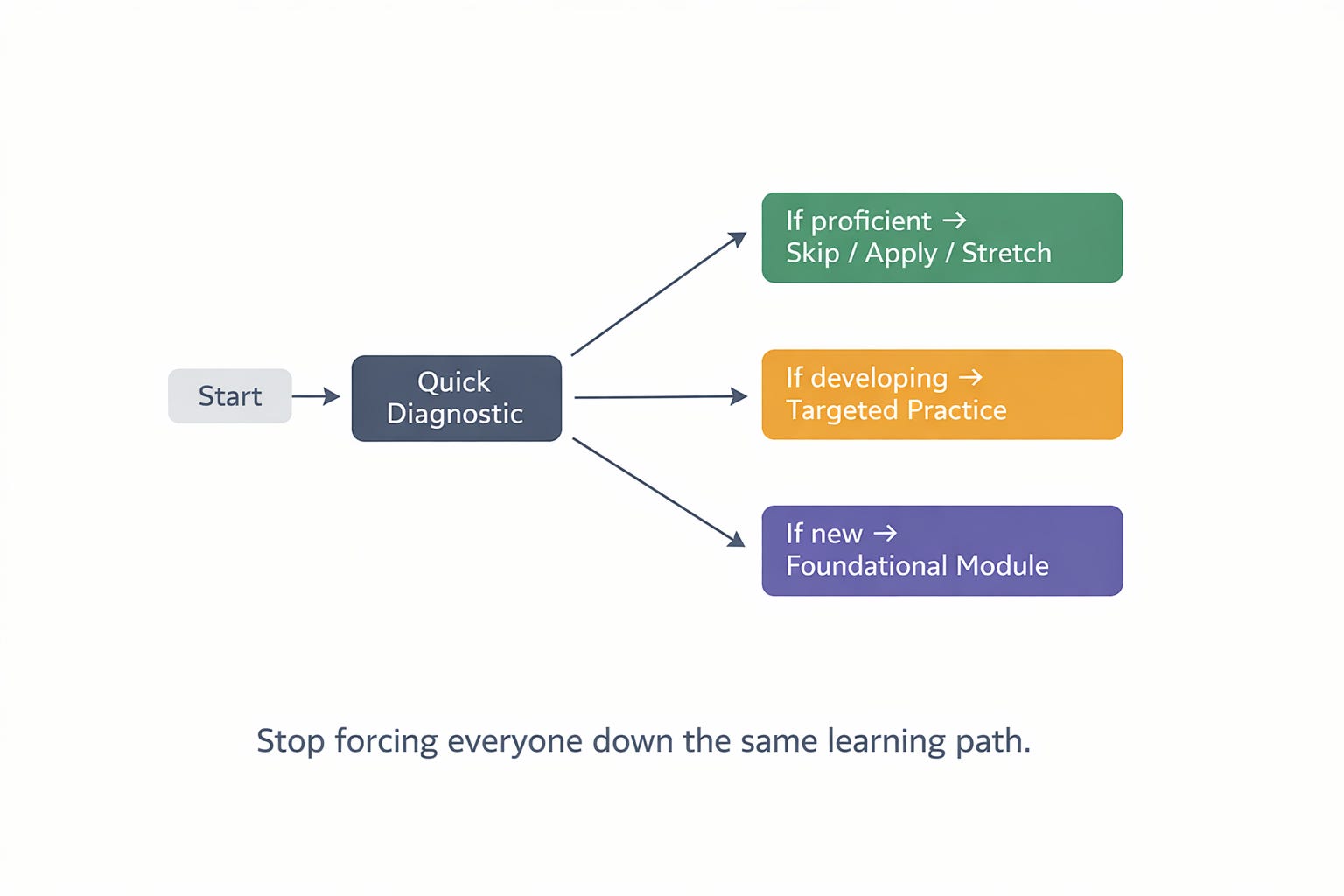
What adaptive learning really means (in practice)
Adaptive learning, in practice, is less about sophisticated platforms and more about a simple shift in mindset. It asks us to stop treating learning like a fixed course everyone must endure and start treating it like a pathway that responds to what people already know, how they perform, and what they need next. Instead of measuring success by completion, we focus on speed to competence. Instead of pushing everyone through the same content, we give people permission to skip, deepen, or practice based on real signals—not assumptions.
This matters now because the pressure to upskill has never been higher, while time, attention, and patience for irrelevant training are at an all-time low. Roles are evolving faster than traditional curricula can keep up, and learners are increasingly resistant to anything that feels disconnected from their day-to-day work. Adaptive pathways help cut through that friction. They reduce overload, respect prior experience, and create momentum by meeting people where they actually are—turning learning from “extra work” into a practical accelerator for performance.
If you’re designing or revising learning right now, try this:
✅ 1. Start with a diagnostic, not a course
Before assigning learning, ask:
What does good performance look like?
What do people already know?
Where do they get stuck?
Even a short scenario, quiz, or manager conversation can help route learners more intentionally.
✅ 2. Design “if/then” learning paths
Instead of one path, sketch two or three:
If someone demonstrates proficiency → offer stretch or application
If they struggle → provide targeted support or practice
You don’t need perfection—just options.
✅ 3. Measure progress, not completion
Shift the conversation from:
“Who finished the course?”
to
“Who can now successfully perform the tasks to the defined level of proficiency?”
That single question reshapes how learning is perceived.
Where might a small adaptive decision such as what to skip, what to deepen, what to practice make learning feel more human and more useful to the individual? If you’re experimenting with adaptive pathways (or wrestling with where to start), share what you’re seeing. What’s working? What’s harder than expected? Your insights help us all learn forward.
If you’re ready to move beyond one-size-fits-all learning and focus on designing practical, adaptive learning strategies—especially when upskilling needs to happen fast, with limited time and budget, let’s talk.
#Upskilling #AdaptiveLearning #LearningDesign #FutureOfWork