
Distance Isn’t the Problem—Unclear Expectations Are.
Hybrid & Remote Work Doesn’t Require More Supervision. It Requires Intentional Design.

I’ve seen teams sitting together underperform and teams separated by thousands of miles outperform. Forcing RTO won’t fix performance problems that were never caused by location in the first place. Distance isn’t the issue. Clarity is.
I have taken remote and hybrid work for granted. I was a “mobile” worker many years ago because I had a “PC” with a handle on it and I was sent to various locations to do my work. I got used to working with teams who worked together in the same office, walked into meetings, and had countless opportunities for informal collaboration.
6 years ago, most of you joined me in understanding what remote and hybrid work is like. and in today’s economy, many teams are distributed across cities, countries, and time zones. Work happens through digital platforms. Collaboration often occurs asynchronously. And leaders are being asked to maintain performance, engagement, and accountability without relying on physical proximity.
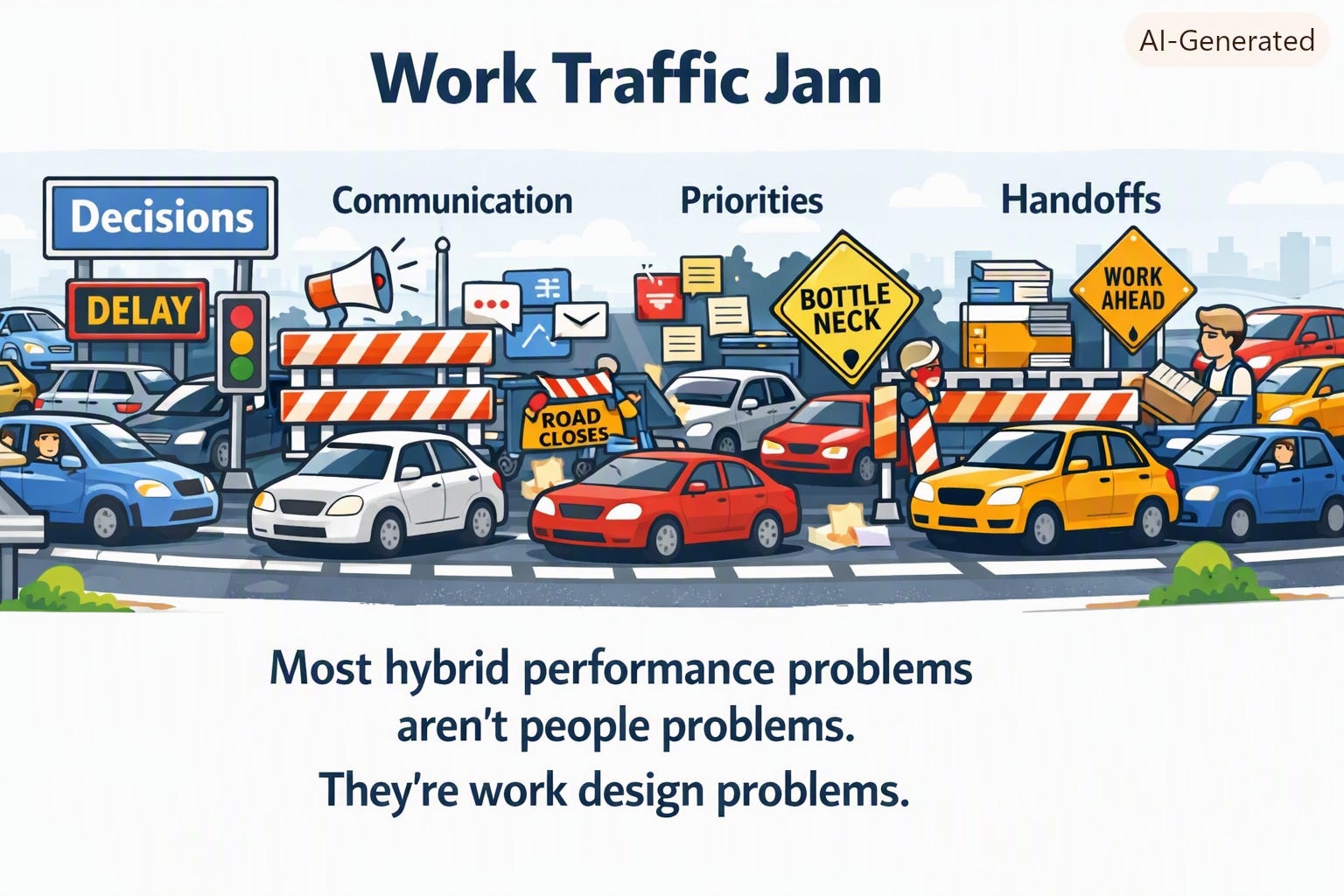
What I’ve learned through all of this is that hybrid and remote work isn’t a location strategy. It’s a performance strategy implemented with clear intentions.
Yet the push many organizations are making bring people back to their real estate is focused on measuring work as a scheduling issue instead of a performance challenge. When a leader tells me they’re struggling with productivity, collaboration, or accountability, my first question is, “How are you measuring people’s performance for how work happens today?” The vast majority are still focused on attendance.
I’ve seen high-performing distributed teams thrive because leaders established clear expectations, decision-making processes, communication norms, and accountability measures. I’ve also seen talented teams struggle because they were operating with assumptions built for a workplace that no longer exists.
Performance doesn’t happen because people share the same location. Performance success happens because people share clarity intentionally.
If you’re leading a hybrid or distributed team, here’s a simple exercise you can do this week to determine where clarity can be improved. Ask:
✅ What information do you need that you’re not getting today?
✅ Which meetings create value and which create noise?
✅ Where does work routinely get delayed? Why?
✅ What expectations seem clear to leaders but unclear to you?
✅ Do you know the metrics that define your performance success?
The answers can reveal performance barriers that no amount of training or technology will solve on their own.
As performance consultants, learning leaders, and business leaders, our role is evolving. We’re no longer simply helping people learn new skills. We’re helping organizations create environments where people can perform at their best regardless of where they work.
That means examining workflows, communication practices, leadership behaviors, decision-making processes, and team norms. The organizations that succeed in the next decade won’t be those with the most office space or the strictest attendance policies.
They’ll be the ones that intentionally design for performance.
That’s where performance consulting, organizational effectiveness, leadership, and workforce strategy come together.
What’s the biggest performance challenge you’ve encountered in a hybrid or remote environment? What practices have helped your teams stay connected, accountable, and effective? Share your experiences in the comments so we can learn from one another.
And if your organization is navigating hybrid work, distributed leadership, performance consulting, or workforce transformation, let’s connect. Because at the end of the day, performance isn’t about where people work.
It’s about how work gets done and enabling people to succeed.
#PerformanceConsulting #HybridWork #FutureOfWork #LeadershipDevelopment #LeadershipStrategy
Couldn't agree more. Unfortunately intentionality seems in short supply at this moment.